


Can Heart Blockages Be Treated Without a Stent?





For years, stents have been the standard treatment for blocked heart arteries. They have saved millions of lives and continue to remain one of the biggest advances in cardiology.
But modern angioplasty is evolving.
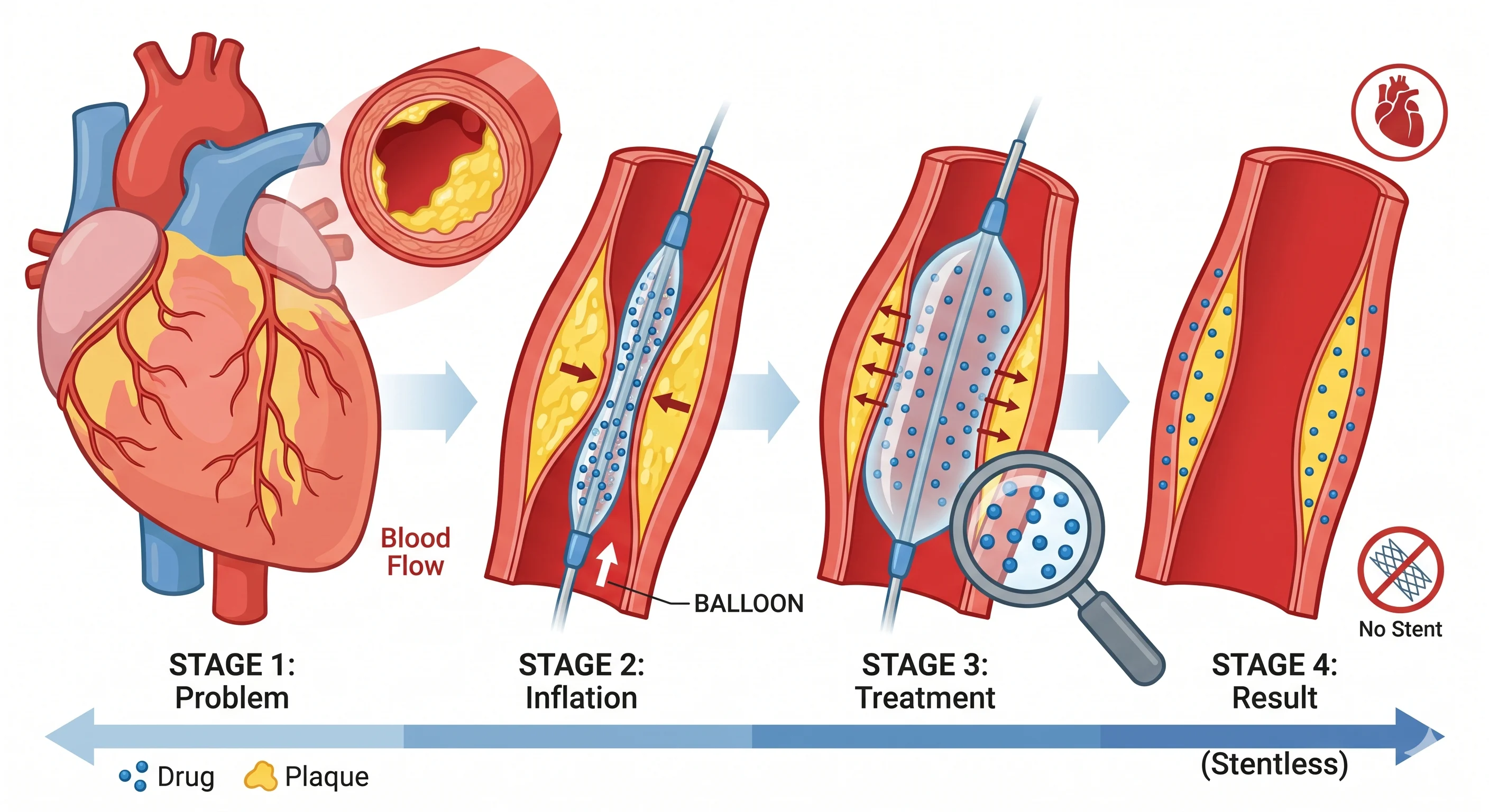
Today, in selected patients, cardiologists can sometimes treat heart blockages without placing a permanent stent inside the artery. This newer approach is called stentless angioplasty. Instead of leaving a metal stent behind, doctors use a special medicated balloon called a drug-coated balloon (DCB). The balloon opens the artery and delivers medicine directly to the vessel wall. Once the procedure is completed, the balloon is removed and nothing is left inside the artery.
This concept is gaining attention worldwide and is often called the:
Leave nothing behind strategy.
How does it work?
The medicated balloon is inflated inside the blocked artery for a short period. The medicine helps reduce the chances of the artery narrowing again.
Unlike conventional angioplasty, there is no permanent metal implant.
Who may benefit?
Stentless angioplasty is not suitable for everyone. It may be useful in:
- Small coronary arteries
- Recurrent blockage inside old stents
- Certain bifurcation lesions
- Patients with high bleeding risk
- Selected younger patients
Careful patient selection is important. In many situations, modern drug-eluting stents are still the best treatment option.
Why is this becoming popular?
Possible advantages include:
- No permanent metal inside the artery
- Better preservation of natural vessel movement
- Reduced multiple stent layers
- In selected cases, shorter duration of blood thinner medications.
Is this the future of angioplasty?
Stents are still the backbone of coronary intervention. However, cardiology is moving towards more personalized and precision-based treatment.
Technologies like IVUS, OCT, lithotripsy, and drug-coated balloons are helping cardiologists choose the right treatment for the right patient.
Stentless angioplasty is one of the most exciting developments in this direction and may play a larger role in the future of heart care.



 ESC
ESC

